Catégorie : Non classifié(e)

  • Rights of nature and ecocide

    Rights of nature and ecocide

    Overview

    Dualism between humans and Nature is rooted in our western societies’ anthropocentric vision of the world. Reinventing our relations with Nature and protecting it is possible through law, and more particularly the rights of Nature.

    Rights of Nature are a relatively new concept prompt to significant evolutions. The objective is the recognition of the legal personality of natural entities, thereby giving themrights “to exist, develop and evolve” and the capacity to legally defend their interests.

    By these rights, we can defend Nature and break her silence. It is not about taking rights away from humans, but about reinforcing the inextricable connection between humans and Nature.

    Objectives

    • To create an environmental law matching the planetary boundaries. Integrating in law the nine systems that regulate our planet’s balance (climate, freshwater, biodiversity, ozone layer…) can be made, for instance, through the recognition of the rights of Nature and the crime of ecocide.
    • To obtain the recognition of the rights of Nature. Granting legal personality to living entities is a highly promising path, taken by several countries (New-Zealand, India, Ecuador…) to guarantee an increased protection of Nature.
    • To create an environmental law genuinely dissuasive and repressive when necessary. Such penal incrimination would bring a true change in current way of living. The recognition of ecocide must be stated in the French criminal code as well as in the Rome Statute establishing the International Criminal Court.
    • To be a source of exhaustive documentation in terms of rights of Nature. Getting a comprehensive vision of the actions building this new area of law and to rise awareness and rally the public to such an innovative topic.

    How ?

    The legal experts and volunteers of Notre Affaire à Tous study and mobilise court ruling and legislation conferring rights to Nature across the world. In the international-oriented law context, we believe this legislation and its opposability may contribute to the evolution of environmental law in France, and it represents a precious resource for our defence.

    We also put to use the growing diversity of tools available to promote a more effective environmental law: by co-organising courts for rights of Nature, by supporting innovative programs dedicated to non-human entities – such as the Parliament of Loire project -, by defending our revendications before citizen bodies of participatory democracy, or by seeking legal remedies in defence of Nature.

    Our actions

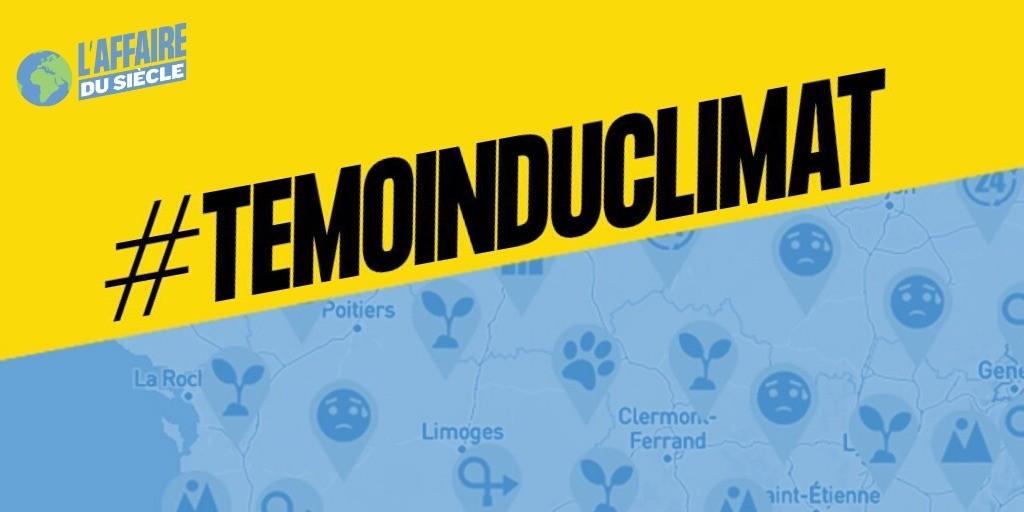
    Climate Witness Mapping

    Convinced that the law can be a lever for citizen mobilization, the Affaire du Siècle has launcheda mapping of the impacts of climate change in France in order to build and sustain a community of citizens affected by climate change. The objective is to alert the public authorities on the seriousness of the situation and the concrete consequences for the French people of its climate inaction, and especially that it acts.


    The legal action of the Affaire du Siècle

    State inaction is illegal ! The state is obliged to respect its national, European and international commitments and to protect its citizens’ human rights. However, France is far from reaching its greenhouse gas emission reduction targets. This is why we are suing the state for climate inaction. Summary motion, supplementary brief, State’s response, find here all the steps of the legal procedure to understand everything about this unprecedented appeal !

    Recognition of the rights of nature in the world

    Une carte d’évènements

    Déclaration des Droits du Manoomin, Etats-Unis (2019)
    Planifié
    Carte droit de la nature
    Réserve indienne de White Earth, Minnesota, États-Unis
    Pétition citoyenne de la ville de Toledo, lac Erie (2019)
    Planifié
    Carte droit de la nature
    Toledo, Ohio, Etats-Unis
    Charte de Broadview Heights, Etats-Unis (2012)
    Planifié
    Carte droit de la nature
    Broadview Heights, Ohio, Etats-Unis d’Amérique
    Bill of Rights du State College, Pennsylvanie (2011)
    du au
    Planifié
    Carte droit de la nature
    State College, Pennsylvanie, USA
    Ordonnance d’arrondissement de Forest Hills, Pennsylvanie (2011)
    Planifié
    Carte droit de la nature
    Forest Hills, Pennsylvanie, USA
    Ordonnance de Pittsburgh, États-Unis (2010)
    Planifié
    Carte droit de la nature
    Pittsburgh, Pennsylvanie, États-Unis
    Ordonnance de West Homestead, Etats-Unis (2011)
    Planifié
    Carte droit de la nature
    West Homestead, Pennsylvanie, États-Unis
    Ordonnance d’arrondissement de Baldwin (2011)
    Planifié
    Carte droit de la nature
    Baldwin, Pennsylvanie, Etats Unis
    Décision de la Cour Suprême de Justice pour l’Amazonie, Colombie (2018)
    Planifié
    Carte droit de la nature
    Palacio de Justicia Alfonso Reyes Echandia, Bogotá, Colombie
    Reconnaissance de l’Amazonie colombienne comme sujet de droits (2018)
    Planifié
    Carte droit de la nature
    Bogotá, Colombie
    Climate Bill of Rights and Protections de Lafayette, Etats-Unis (2017)
    Planifié
    Carte droit de la nature
    Lafayette, Colorado, Etats-Unis
    Résolution de Crestone, Etats-Unis (2018)
    Planifié
    Carte droit de la nature
    Crestone, Colorado, Etats-Unis
    Inde – Jugement de la Haute Cour de Uttarakhand (2018)
    Planifié
    Carte droit de la nature
    Uttarakhand, Inde
    Charte du comté d’Orange, Etats-Unis (2020)
    Planifié
    Carte droit de la nature
    Comté d'Orange, Floride, Etats-Unis
    Décision de la Haute Cour du Bangladesh, rivière Turag (2019)
    Planifié
    Carte droit de la nature
    Rivière Turag, Bangladesh
    Loi du Parlement néo-zélandais, Fleuve Whanganui (2017)
    Planifié
    Carte droit de la nature
    Fleuve Whanganui
    Moratoire sur l’exploration et l’exploitation du pétrole dans la zone maritime du Belize (2017)
    Planifié
    Carte droit de la nature
    Belmopan, Belize
    Extension de l’Habeas corpus aux animaux (2017)
    du au
    Planifié
    Carte droit de la nature
    Barranquilla, Colombie
    Décret du gouverneur de Nariño (2019)
    Planifié
    Carte droit de la nature
    Pasto, Nariño, Colombie
    Décision de la Cour Constitutionnelle d’Equateur, forêt Los Cedros (2019)
    Planifié
    Carte droit de la nature
    Forêt Los Cedros, Equateur
    Amendement du Parlement Ougandais du National Environment Act (2019)
    Planifié
    Carte droit de la nature
    Kampala, Ouganda
    Ordonnance municipale de Yellow Springs, Ohio (2012)
    Planifié
    Carte droit de la nature
    Yellow Springs, Ohio, USA
    Ordonnance municipale de Tamaqua Borough (2006)
    Planifié
    Carte droit de la nature
    Tamaqua, Pennsylvanie, Etats Unis
    Loi du Parlement Néo-Zélandais, Te Urewera (2014)
    Planifié
    Carte droit de la nature
    Te Urewera, Ile du Nord, Nouvelle-Zélande
    Loi du Parlement de l’État de Victoria, Fleuve Yarra (2017)
    Planifié
    Carte droit de la nature
    Yarra River, Australie
    Propositions de loi visant à faire reconnaître les droits de la Nature (2015 et 2017)
    du au
    Planifié
    Carte droit de la nature
    Buenos Aires, Argentine
    Acte local de Santa Fe (2018)
    Planifié
    Carte droit de la nature
    Santa Fe, Argentine
    Amendement de la loi organique, Florianópolis (2019)
    Planifié
    Carte droit de la nature
    Florianópolis, Brésil
    Code de l’environnement de la Nouvelle-Calédonie, Province des Îles Loyauté (2016)
    Planifié
    Carte droit de la nature
    Wé, Lifou, Nouvelle-Calédonie
    Adoption d’une Constitution tournée vers une approche écocentrée (2009)
    du au
    Planifié
    Carte droit de la nature
    La Paz, Bolivie
    Loi sur les droits de la Terre Mère
    du au
    Reprogrammé
    Carte droit de la nature
    Bolivie
    Loi sur les droits de la Terre Mère (2010)
    Planifié
    Carte droit de la nature
    La Paz, Bolivie
    Loi Cadre de la Terre Mère et du développement intégral pour le Bien Vivre (2012)
    Planifié
    Carte droit de la nature
    La Paz, Bolivie
    Décision en faveur des droits des animaux (2019)
    Planifié
    Carte droit de la nature
    Brasilia, Brésil
    Résolution du Conseil de la Tribu Yurok, rivière Klamath (2019)
    Planifié
    Carte droit de la nature
    Rivière Klamath

    Our resources

    Our other actions

  • Climate Witness Mapping

    Climate Witness Mapping

    BECOME A WITNESS OF THE CLIMATE EMERGENCY IN FRANCE!

    For its first anniversary, the Case of the Century is launching a call for testimonials on the effects of climate change in France..

    One year after the launch of the Case of the Century, there is no State reaction and no decision commensurate with the climate challenge. And yet, there was no shortage of scientific reports reminding us of the urgency to act in 2019… Still waiting for the formal response of the State to our arguments, we intend to continue the mobilisation, open the eyes of the State and urge it to act.

    Citizens are called upon to act as #TémoinDuClimat (ClimateWitness) in order to map the impacts of climate change in France. Everyone can testify! Because we are all witnesses or direct victims of climate change… You can declare yourself #TémoinDuClimat on social media or go to the l’Affaire du Siècle website to give your testimony on the map.

    You too,share the changes you are witnessing (rising temperatures, extreme weather events, coastal erosion, disturbed plants and animals…), and describe how you are being impacted. Your testimonies will constitute an unprecedented map of the climate situation in France.

    Together, let’s alert public authorities of the seriousness of the situation so that the State responds to our case and, above all, takes action. We want to show them that citizens all over France are already suffering from its inaction. There is strength in numbers: it is indeed the 2.3 million signatories who have given so much power and visibility to the Case of the Century. So the more we are, the more our message will be heard!

    I testify on the cartography

    Some of these testimonies may be included in the legal file by the lawyers of the Case of the Century (subject to your agreement).

    Video explanation

    Read the press release


    Read the press kit

    THEY TESTIFIED

    We are organic farmers and we observe nature in our daily life. The drought has given way to floods. Insects are becoming rare. I am afraid for our agricultural project, for our income, for the future of our children.

    Héloise, 47 ans, Caubon-Saint-Sauveur

    In 20 years, I’ve witnessed three storms. For me, climate change – with the increase in the frequency of natural disasters, rising sea temperatures, and increasing coastal erosion – is already here.

    Jean-François, 70 ans, Saint Pierre d’Oléron

  • The Andean cosmovision as a philosophical foundation of the rights of nature

    By Ilona Suran, member of Our Common Cause

    The rights of Nature are built on an indigenous thought and belief that embraces life, and recognizes, in this sense, the omnipresent interdependence that binds all natural entities together, of which humans are part. We are complementary expressions of the same living, collective and cyclical being, Pachamama.

    THE LOSS OF OUR ROOTS THROUGH A DESTRUCTIVE WESTERN CULTURE

    The West today positions itself as the great guarantor of hedonistic, individualistic and utilitarian thinking, and is above all concerned with excessive consumerism (1). It seems to neglect to some extent the importance of the social link, of human well-being, of solidarity, of love and mutual aid and rejects any idea of interdependence that humans might have with Nature. The anthropocentrism displayed by our societies sees Man as the only moral subject, the only bearer of dignity and intrinsic value. It is the central agent that regulates actions, values and ethical models. This dualistic vision dissociates the human being, holder of a spirit, from the rest of the world, a sum of « inert » objects. This is reinforced when one listens to the words of Descartes and Aristotle, who understood Man as the sole holder of reason, making him sovereign and the measure of all things (2). It is at the heart of the concerns. In this respect, François Ost perfectly relays this Cartesian thought (3) and the fact that Western modernity « has transformed nature into an ‘environment’: a simple setting in the center of which man, who proclaims himself ‘master and possessor’, is enthroned ».

    Western culture thinks of the earth as a thing, a good, that can be dominated, subdued, exploited, with relative contempt for all animal and plant suffering. And it is by proclaiming Man as the great ruler of the living world, that we have lost our way, away from our roots. We have forgotten that Nature is not just a marketable resource, but the matrix of all life – including human life. It is this Earth ecosystem that cradles us, feeds us, shelters us and keeps us alive. And yet, we are in perpetual war against life, with permanent dissatisfactions, mercantile appetites, and human misunderstandings. Capital and the logic of profit have taken precedence over any other societal objective, increasingly threatening limited natural resources, biological diversity, ecosystems and landscapes. The liberal-capitalist system is in the process of destroying the biophysical conditions of existence (4). Pollution is raging, while the climate is going crazy and biodiversity is crying out for help. Swept of a reverse side tainted of instrumentalism, the Nature is not any more, it is denatured of its substance; it is not so much a source of metaphysical meanings thanks to which to understand, to feel, to symbolize aesthetically and spiritually, that a resource to be exploited, a « natural resource », violated and disabused.

    So, the model of society in which we are enrolled must be absolutely questioned; the way in which it evolves and functions does not cease to feed social inequalities and environmental destruction, largely endangering the conditions of existence on Earth. We must at all costs break with this Cartesian and scientistic vision of the world, rethink the theoretical foundations of modern societies, and open ourselves to those cultures that think of Life in a completely different way.

    THE ANDEAN COSMOVISION, IN HARMONY WITH THE LIVING

    Many peoples throughout the world are at the opposite end of the anthropocentric spectrum, and have a more holistic view of life and a profound respect for ecological balance. The vision of a world in harmony where Man is in fact a component of the biosphere within which all living organisms evolve. In reality, in the image of the cosmovisions of the Andean indigenous peoples, Nature is no longer an environment external to the human, it is the human, and the Man is Nature (5). A biocentric approach that dethrones Man from his pedestal, and roots him in his origin.

    For the sake of clarity, the semantics of some terms related to the cosmos must first be briefly studied. While cosmology is understood as the science of the general laws that govern the Universe, this « more or less coherent set of representations concerning the form, content and dynamics of the Universe: its spatial and temporal properties, the types of being found there, the principles and powers that account for its origin and their becoming » (6). Cosmogony, on the other hand, is based on orality and memory, and is a matter of sacred stories, told to explain the genesis of the world and of humanity; it is fundamentally based on myths linking beliefs and realities, legitimizing social practices and justifying the order of the world and the social link (7). In its continuity, almost sororal, the cosmovision comes to assert itself as a perception of the Universe, a set of beliefs allowing to analyze and to recognize the reality from the very existence. It is a truth of the world and the cosmos thought by a person, a society or a culture at a given time, gathering in itself all the aspects of life, religion, politics, philosophy, morals, manners and customs.

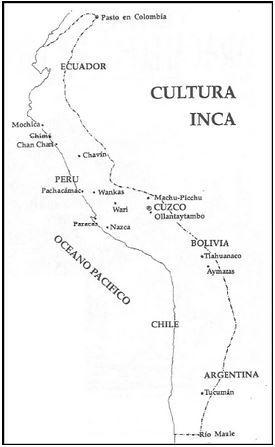
    Thus, the Andean cosmovision is based on thousands of years of culture, beliefs, conquests and civilizations; it is an Andean mixture extending from Colombia to Chile, passing through Ecuador, Peru, Bolivia and Argentina. In spite of this ethnico-cultural disparity of the pre-Columbian civilizations (8), the Andean culture holds in a lot to the Peruvian one because of the role that some Peruvian peoples and empires will play throughout the history. The original Quechua peoples then materialized 5000 years ago, a way of interpreting the world and perceiving it, first within the Civilization of Caral, then, until the Incas, who survived until then.

    This last Inca Empire bases its origin on certain legends, one of which tells the birth of two children, Manco Capac and his sister-wife Mama Occlo. Fruits of the union between the Sun-Father, Taita Inti, and Mother Earth, Pachamama, their mission would be to find a land to build a new civilization. Then if it was relatively short-lived (1450-1532) (9), this Empire was nevertheless the vastest of the pre-Columbian America. À son apogée, il s’étend le long de la Cordillère des Andes, perché à plus de 2000 m d’altitude au dessus du niveau de la mer, de l’Equateur au Chili, dont Cuzco au Pérou en est la grande capitale, « le nombril du monde ». This dynasty disappeared in 1532 defeated by a troop of barely 200 Spaniards, guided by Francisco Pizzaro, who took advantage of family disagreements related to the successions and the fragility of the people, to deceive the emperor Atahualpa, and to commit ignoble acts in order to reduce to nothing the civilization. Despite the disappearance of the last official Inca emperor, the beliefs and customs have been perpetuated over the centuries, reinforcing this Andean vision of the world and the care it intends to give to Nature, to the living Cosmos, and to the sacred relationship between human beings and Mother Earth. It must be mentioned, however, that in view of the colonization that was carried out from the 16th century, and whose grand slam was to evangelize en masse and subjugate at will, the Andean and indigenous animistic beliefs (10), if they were not extinguished, were practiced in a relatively silent way. The millenary ritual allocated for the Pachamama, which in a more western way, can be related to Gaia (11), even if it remains a more complex and profound entity, is one of the only archaic pre-Columbian paradigms that survived the evangelization. Therefore, it is common to meet this mixture and this ethnological mosaic within ceremonies for the Pachamama, where the Virgin Mary is related to it, she is essence of a whole, she gives life.

    As an interpretation of a whole, the Andean cosmovision is a point of convergence between religious and social beliefs, it advocates this sacred link that links the human being and the cosmos, the sky and the earth. The Cosmos is alive and everything in it is intertwined, every entity that makes it up. She admits that everything takes shape in what she calls theIlla Teqsi, « Eternal Light; Foundation of Light », which is then the energy by which the Universe was formed, the primary substance that animates it, the matrix that gives it form and movement. This omnipresent and positive energy, which expresses itself through each being, and links us, humans, to Mother Earth, the Pachamama, circulates unceasingly within Nature, considered as a whole. An ethics of whole life that could endorse this saving term that represents Pachamama. It is common to find Pachamama translated and symbolized by Nature, but this is a mistake (12) in that the term « Nature » does not exist in any way in the indigenous communities, it is a western construction dressed to differentiate the human being from the rest of the wild (13). To reduce the ethics and thought of Pachamama to this simple connotation of Nature is a tasteless shortcut that ignores the knowledge of indigenous peoples.

    Pachamama holds a variety of meanings, it is a complex notion. It is not the result of scientific elaborations, but the manifestation of the knowledge of the ancestral culture, fruit of a coexistence of the people with the Living. Divinity with Andean roots, it represents the whole of the human and non-human entities, from the human, to the animals; from the plants, to the rivers, oceans until the rocks and the stars (14). She is the Mother Goddess. « Pasha » is the earth, nature, planet, living space, time, universe, world, cosmos, and more. These different aspects complement each other; it is « Space-time » and it is « Universe ». Pascha is the All, she is the Great Spirit: « Pascha and her spirit are one, although we all participate in her spirit » (15). While « Mama » is of course the mother, the womb of life, who cradles and protects the beings she gives birth to, the whole of the Living. Pachamama is a true universal intelligence, divine and mystical, she gives rhythm to the spiritual beliefs of the ancestral peoples, who allot her a true devotion estimating this sacred, this divine force that she embodies. The ancestral culture is organized around rites and cults for this feminine entity, understood in its cultural dimension as Mother Earth, without devoting a particular spiritual edifice to it, because it is its own temple, Nature (16). An entity recognized by all the peoples of South America, who pay homage to it for the Life that it carries, considering it as « a living reality, a part of their own human nature, with which they maintain exchanges and reciprocities, but also recognitions and mutual identifications » (17). This conception of the macrocosm at the Incas is unceasingly articulated around a duality, of a search of the harmony of the opposites, what returns to accept the very essence of the Universe (18). As much as the Inca cosmogony embodies the feminine energy of Pachamama, it also recognizes the existence of a masculine force, Pachataita, the Sky Daddy, who together form this fertile Andean duality.

    In the same way, the Andean sensibility understands that every constitutive element of the Cosmos is intertwined, that every being is endowed with a spirit, whether it is mountains, rivers, trees, plants, or even rocks. It understands the world as a natural community of diverse and variable living communities, all of which, because of the bond that unites them, represent both their intrinsic value and the Whole. In reality, this means that in each entity, the micro and the macro-cosmos are linked. By understanding our inner self, our own body, it is then possible for us to hear the whole Universe; the Laws of Nature, these biological laws, are identical, regardless of births and conceptions of the Living. In this sense, and in order to integrate well the stakes of such a perception of the Cosmos, it is necessary to mention this very particular way that the Andean cosmovision has to conceptualize the time. It is necessary to understand that the notion of time for these ancestral peoples is very far from the western one which wants to be rational and which paradoxically desires without moderation and at full speed; where each disturbance comes to dethrone the balance of a whole ecosystem, disturbing the wellbeing of its components.

    The indigenous temporality is much closer to that of Nature and its natural and biological processes, where the appreciation of time is quite different. The Andean cosmovision recognizes then three dynamic and complementary spaces which articulate to form the Cosmos, three Pachas, Hanan Pacha, Kay Pacha and Uku Pacha. At first glance, it is not easy to understand its meaning. However, it is possible to understand Uku Pasha as the past time, that which was, that world which is no longer, but which continues to exist in a certain way; it is the underworld, that of the dead and of past souls, the root that supports a whole, the depths of the earth, but also the cradle of the seeds that will be reborn, represented by a serpent. The Kay Pacha, the human realm, of the immediate, the here and now, where nothing is static, and everything is in perpetual motion as time goes by (19), where everything materializes, is seen, felt and perceived, which captures our consciousness. It is a bridge between the past sphere and the one to come, an eternal oscillation of time that maintains this cyclic interrelation with the two Pachas, embodied by a panther. Hanan Pacha, the superior kingdom, the world of the skies, where live as animated beings, rivers, stones, trees and animals, where natural phenomena and the Andean gods interact, symbolized by a condor. Linked to the spiritual world, it represents what is to come. The articulation of these three levels form the cosmos, where the micro and the macro-cosmos maintain an intimate correspondence.

    THE LIFE ETHIC OF BUEN VIVIR

    A key concept attached to this indigenous philosophy is that of Buen Vivir, which refers to the indigenous paradigm of living in harmony between human beings and Nature. It implies a holistic and integrated vision of the human being, immersed in the great earth community that includes water, air and soil, mountains, trees and animals. It is in fact a true harmonious symbiotic relationship, it is the affirmation of a deep communion with this recognized and prayed divinity, Pachamama, with all the energies of the universe and with God. The Buen Vivir or Sumak kawsay in Quechua, is what we can call a culture of life, which thinks of new forms of organization and development between people, of interaction with the Living and of understanding the world and its metaphysical relations. So the invocation of Pachamama is naturally accompanied by the requirement of respect for her, which is translated into this fundamental ethical norm of Sumak kawsay. And as the Preamble of the Ecuadorian Constitution of 2008 states, it is « by celebrating nature, the Pachamama, of which we are part and which is vital for our existence… [que nous décidons de construire] a new form of citizen coexistence, in diversity and in harmony with nature to live well (or live fully), the Sumak kawsay » (20). Of course, this ethic of life is a philosophical construction carried by many indigenous peoples, which is not limited to the Inca people of Peru; it is all the Andean and Amazonian indigenous communities that represent this alternative to development (21). It is these traditionally marginalized peoples who question this ethic of « living better » insofar as unlimited progress and the competition of individuals lead to unprecedented social fractures and inequalities, and a murderous destruction of our common home, the Earth. It is not a negation of the modern Western world, but an invitation to a permanent and constructive dialogue of ancestral knowledge and wisdom with modern universal thought, with the aim of continuous decolonization of society. This ethic thinks of the harmony between all the individuals of the planetary ecosystem, and more particularly between the human world and the so-called non-human sphere. A particular representation of life and of the way we interact with it, which supposes a regime based on solidarity and no longer on a model of free competition that animates a certain economic cannibalism between human beings. The aspiration to a social and solidarity economy that allows an egalitarian and inclusive recognition of the different forms of work and production. Buen Vivir clashes with the system of global capitalist accumulation that sucks raw materials – that is, Nature – causing serious environmental damage, as well as maintaining a structure of exploitation of human labor, in contradiction with good working conditions. Then rises this paradigm of change of the world and its rules to build a democratic society more sustainable, fair, egalitarian, free and certainly, more human.

    THE APPLICATION OF AN ANCIENT PHILOSOPHY OF LIFE TO MODERN THEORIES OF LAW

    This doctrine of life is becoming more and more pervasive in Western societies, even penetrating the foundations of its law. It is a key teaching of the rights of Nature (22) and an essential safeguard for the maintenance of good living conditions on Earth. Indigenous societies remind us of our duty to reconnect to the earth, to our neglected biological laws, they call us to a profound return to solidarity and resilience. An ethic of life that breaks completely with the anthropocentric liberal constitutionalism where the human is at the heart of the concerns. It proposes a real change of civilization. It is from this that the will to grant rights to the Earth’s ecosystem and to the community of the Living is born as the foundation of a culture of profound respect for life, its components and its natural cycles. It is essential to recognize the intrinsic value of each natural entity, as well as the interdependence of each of them – humans, plants, animals, minerals, micro-organisms – in order to consolidate the well-being of humanity, of the great community of life and of future generations. The maintenance of good living conditions on Earth depends on it So, the law invites to the journey to consider this affectionate and visceral relationship that the indigenous communities maintain with the planetary ecosystem, apprehending it as the Mother Earth, Pachamama, perceiving the need to restore its health and the ecosystems that compose it, in a holistic and integrated way, in a systemic way (24)

    Pachamama, in which life is produced and realized, has the right to the integral respect of its existence and to the maintenance and regeneration of its vital cycles, its structure, its functions and its evolutionary processes. The esteem in which it is held is based on the philosophy of Buen Vivir, which is positioned in the movement of the rights of Nature, in that it advocates respect and harmony with the Living, recognizing its true intrinsic value. Human rights, as well as the rights of Mother Earth, are then complementary faces of this philosophy of the Good Life, a solution to the current dilemma of Humanity. Faced with the threats to the ecological balance and the habitability of the Earth, we must urgently rethink the legal foundations of our societies in an eco or even biocentric manner (25) and accompany the emergence of a movement to shift environmental law towards an ecological law.

    Environmental law, which intends to protect the environment under the aegis of an anthropocentric vision, is confronted with ecological law, which apprehends legal science as an instrument allowing the protection of ecosystems for their own sake, of which Man would no longer be the core, but one of its components, in the same way as the rest of the natural entities. It seems necessary to admit as a new pivotal value, the intrinsic value of Life, whose law in a general way must be able to universalize around this notion and recognize the biosphere as the ultimate subject of law. The legal paradigm of the rights of Nature then apprehends the Earth as the source of the natural laws that govern life, where the human being is neither creator nor principal actor, but an entity like any other. All that comes from Creation (26), all beings that have a life are no longer mere objects, they are true subjects, and can be endowed with a legal personality. A new model is emerging that considers the recognition of rights to ecosystems and biocenosis, where each entity of the biosphere has its own value in that it plays a role in the functioning and regeneration of ecosystems and their cycles.

    So in other words, to defend Nature is to defend Nature’s right to be Nature. This new movement of law is forged from the ancestral indigenous traditions that advocate that the existence of each member of the indivisible community of life is interdependent on that of the whole, and therefore that any attack on Nature is in reality an attack on humanity itself. So ineluctably, to defend the right of Nature to exist is to defend even more effectively the fundamental rights of Man, such as his right to life, to safety, to health or to food (27). This visceral relationship that links ancestral culture to Nature is a real traditional knowledge, first transmitted orally and then recently institutionalized (28) through the Federal Constitution of Ecuador (29) and the federal legislation of Bolivia (30). Indeed, countries with a large proportion of indigenous people in their population are bound to be the most inclined to constitutionally recognize the entity of Pachamama and the Buen Vivir doctrine of life. These two Latin American States are great pioneers and symbolize this legal opening which wishes to exceed these outdated Western standards to recognize true personalities to the natural elements and the biotopes which shelter them. The rights of Nature take their strength within the Andean cosmovision and its philosophy of Buen Vivir, which invite to the harmonious and respectful balance between human beings and the rest of the Living. The main point tends to be the awareness that we are part of an interdependent whole in which each element plays a specific role within the Earth ecosystem. A Whole, which is intrinsically penetrated by a cosmic and divine force, the very matrix of Life, regularly represented as God, here implied without particular religious distinction.

    So in itself, the rights of nature are not so much a revolution, but rather an inter-cultural dialogue. This way of considering Nature as having a personality, a dignity that must be respected, is not really innovative. The First Peoples have thought of it and respected it in this way for centuries; they produce their own legal norms according to these guiding principles. Yet, because of this exclusionary Western colonialist tradition, the rights developed by « minorities » such as these primary peoples are prevented from being absorbed into positive law (31). They remain a dead letter at the gates of globalization. So, to revive this paradigm that intends to give rights to the natural elements, is to take a philosophy that is already alive and well, and adapt it to rethink the theoretical matrices of the conception of positive law. It is then to break with these foundations of exclusion of the subaltern, marginal groups, and to give again legitimacy to their knowledge, their ethics and their wisdom. It means creating – at last – a true dialogue between cultures, going beyond the Man/Nature dichotomy, as many peoples have already done, and recognizing that the law can indeed be pluralist.

    NOTES

    1. V. CABANES, « Un nouveau droit pour la Terre – pour en finir avec l’écocide », Seuil, 2016, p.27
    2. S. GURTWIRTH, « Trente ans de théorie du droit de l’environnement : concepts et opinions », Environnement et société, n° 26, 2001, p.7
    3. R.DESCARTES, Discours de la méthode, 1637, p. 38, [En ligne] http://classiques.uqac.ca/classiques/Descartes/discours_methode/Discours_methode.pdf
    4. A. ACOSTA, El Buen Vivir en el camino post-desarrollo – Una lectura desde la Constitución de Montecristi, Policy Paper N° 9, Fundación Friedrich Ebert, 2010, p.18 ; [En ligne] http://library. fes.de/pdf-files/bueros/quito/07671.pdf (consulté le 19/04/2021)
    5. Carta do 7º Congresso Internacional Constitucionalismo e Democracia: O Novo Constitucionalismo Latino americano – Harmonia com a Natureza e Bem Viver, Carta de Fortaleza : Manifesto Pachamama, Fortaleza (Brésil), 29/11/2017 : [En ligne] https://www.nacionpachamama.com/manifestopachamamaemportugues (consulté le 19/04/2021): « Nous sommes un même organisme vivant. Nous sommes la Terre-Mère : Pachamama. Il semble que nous soyons séparés, cependant, tout ce qui existe naît du même ventre. Les eaux, les oiseaux, les fleurs, les hommes et les montagnes sont les expressions complémentaires d’un être vivant, collectif et cyclique »
    6. P. BONTE, Dictionnaire de l’ethnologie et de l’anthropologie, Izard Michel (éds), 1991
    7. R. BARTHES, Mythologies, Seuil, broché, 1957
    8. C’est-à-dire avant l’arrivée de Christophe Colomb et de ses troupes espagnoles en Amérique (1492)
    9. Dates de l’empire à son apogée, l’Empire en soit apparait vers 1350 avec Manco Capac.
    10. L’animisme : « l’imputation par les humains à des non-humains d’une intériorité identique à la leur », P. DESCOLA, Par delà nature et culture, Gallimard, 2005, p.183 – it is to attribute a spirit to any living being, to any object but also to any natural element like the stones or the windDates of the empire in its apogee, the Empire in itself appears around 1350 with Manco Capac.
    11. J. LOVELOCK, Gaia, a new look at life on earth, Oxford University Press, 1979 – This theory sees in the Earth, a living super-organism, Gaia, far from an inanimate assembly of gas and rocks, it would be a living being in its own right, capable of self-regulating like no other planet yet known
    12. L. ESTUPINAN ACHURY, C. STORINI, R. MARTINEZ DALMAU, F. CARVALHO DANTAS, La naturaleza como sujeto de derechos en el constitucionalismo democrático, Bogotá: Universidad Libre, 2019, p. 284
    13. P. DESCOLA, Par-delà nature et culture, Gallimard, 2005
    14. R. FERNANDEZ, « Constitucionalismo plurinacional en Ecuador y Bolivia a partir de los sistemas de vida de los pueblos indígenas », thèse de doctorat, Université de Coimbra, 2017, p.109 ; [En ligne] https://estudogeral.uc.pt/bitstream/10316/36285/2/Constitucionalismo%20plurinacional%20en%20Ecuador%20y%20Bolivia%20a%20partir%20de%20los%20sistemas%20de%20vida%20de%20los%20pueblos%20ind%C3%ADgenas.pdf (consulté le 19/04/2021)
    15. V. PINEDA, Cultura peruana a historia de los Incas, Fondo de Cultura Económica, Lima, 2001, p.333
    16. E. ZAFFARONI, La Pachamama e el humano, Madres de Plaza de Mayo, Colihue, Argentine, 2011, p.118
    17. F. CAMPAÑA, « Los derechos de la Naturaleza en la Constitución ecuatoriana del 2008 : alcance, fundamentos y relación con los derechos humanos », Revista Esta 17, 2019, p.242
    18. F. MARTINAT, La reconnaissance des peuples indigènes entre droit et politique, deuxième partie, Cosmovisions indiennes et conflits de représentation, Presses universitaires du Septentrion, 2005
    19. L. JAVIER, Qhapaq Ñan: la ruta Inka de Sabiduría, CEnES, Lima (Perú), 2003, p.148-149
    20. E. ZAFFARONI, La Pachamama e el humano, Madres de Plaza de Mayo, Colihue, Argentine, 2011, p.111
    21. A. ACOSTA, O Bem Viver – Uma oportunidade de imaginar outro mundo, tradução de Tadeu Breda – São Paulo : Autonomia Literária, Elefante, 2016
    22. Also called rights of Mother Earth or rights of the Pachamama
    23. V. CABANES, Un nouveau droit pour la Terre – Pour en finir avec l’écocide, Editions du Seuil, 2016, p.281
    24. V. OLIVEIRA, « Dignidade Planetária no Capitalismo Humanista », thèse de doctorat, Université Catholique de São Paulo, 2014 ; [En ligne] https://tede2.pucsp.br/bitstream/handle/6671/1/Vanessa%20Hasson%20de%20Oliveira.pdf (consulté le 15/04/2021)
    25. See in this sense the article of Xavier Idziak, « Ethique environnementale et droits ; réflexions autour d’une évolution de la perception du droit », blog Notre Affaire A Tous, 6/01/2021 ; [En ligne] https://notreaffaireatous.org/ethique-environnementale-et-droits-reflexions-autour-dune-evolution-de-la-perception-du-droit/ (consulté le 16/04/2021)
    26. Understood here as the divine creation, matrix of all life
    27. Article 3 and Article 25 – Déclaration Universelle des Droits de l’Homme, 1948
    28. E. MARTINEZ, A. ACOSTA, La Naturaleza con Derechos – De la filosofía a la política, Serie Debate Constituyente, Abya Yala, Quito (Equateur), 2011, p.112
    29. Préambule et article 71 – Constitution équatorienne de 2008
    30. Loi n°071, Loi des Droits de la Terre Mère, Assemblée Législative Plurinationale de Bolivie, 21/12/2010 : « For the purpose of protection and protection of its rights, Mother Earth has the character of a collective subject of public interest. Mother Earth and all its elements, including human communities, have all the inherent rights recognized in this law, and its application will take into account the specificities and particularities of its various elements.
    31. This term is understood as the set of legal rules applicable and in force in a State at a given time

  • The legal action of the Affaire du Siècle

    The legal action of the Affaire du Siècle

    Why turn to the courts ?

    State inaction is illegal ! The state is obliged to respect its national, European and international commitments and to protect its citizens’ human rights.

    Climate justice is inseparable from social justice ! The French have understood it well, through the crisis of yellow vests. The victims of climate change are now visible. Maurice Feschet and Jean-François Périgné suffer a loss of income from their work linked to the deterioration of the climate. Magali Duranville deplores the endangering of the health of the French, their family lives, their homes. Citizens have clearly understood the widening gap between words and deeds, and that nothing is really being done today to counter the current climate crisis. Yet France is the European country most affected by the impacts of global warming. But the costs of the transition fall on the poorest.

    All means of action have been used: individual actions, citizen mobilizations, boycotts as well as non-violent resistance. But neither the big polluters nor the States have answered the citizens and scientists calls for climate action.

    Today, France is not keeping its commitments, even those it has set for itself. If the French respect the law, the States also have an obligation ! The State is responsible, it must act directly, and regulate the activity of polluters.

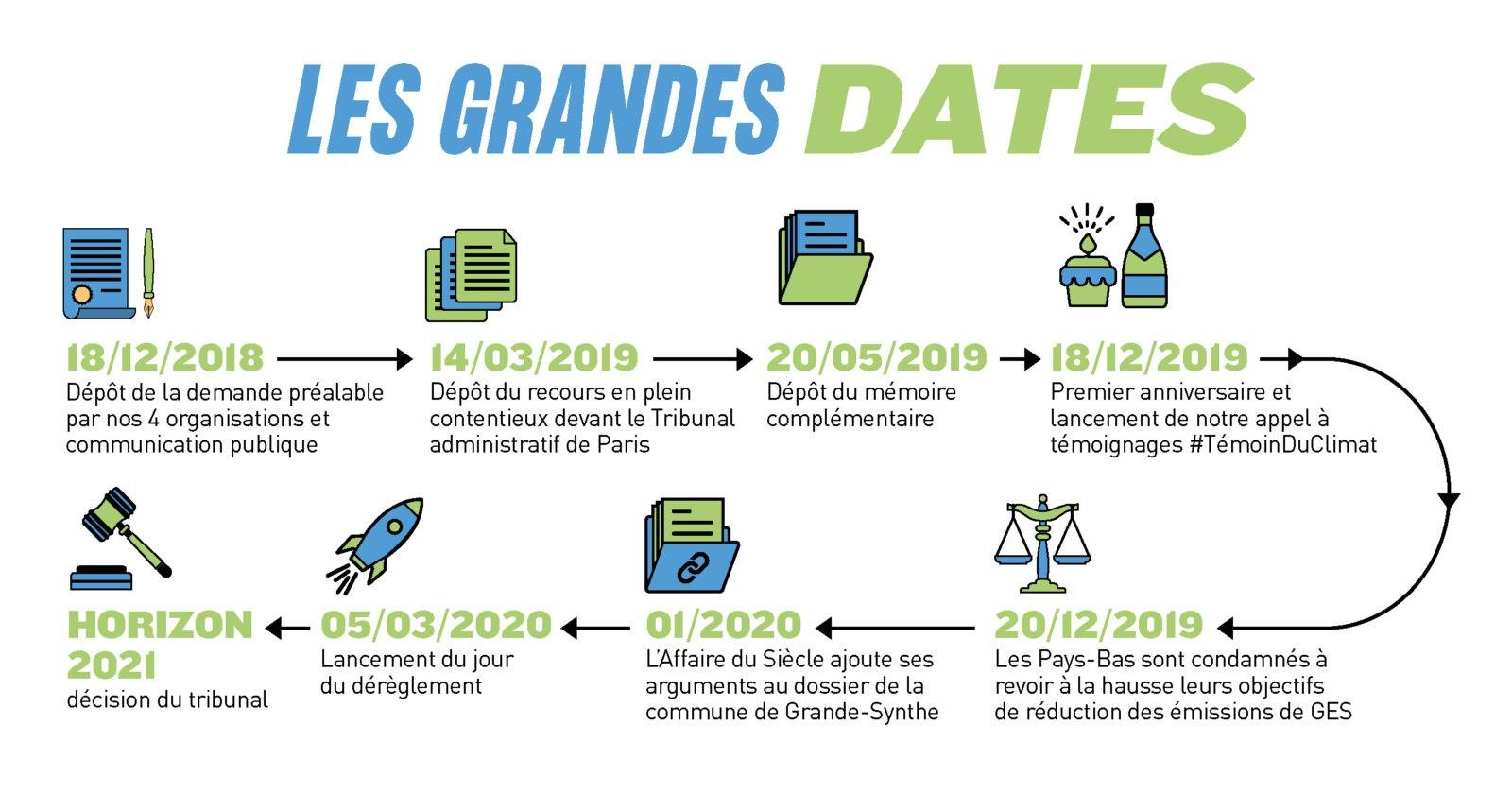
    December 18, 2018: launch of the Case of the Century

    On the 18th of December 2018, Notre Affaire à Tous, in partnership with the Fondation pour la Nature et l’Homme, Greenpeace France and Oxfam France, initiated « l’Affaire du Siècle« , the climate litigation case against the French State. Its aim is to have a legal judge recognising the general obligation of the French State to act in the fight against climate change, thus protecting French citizens’ rights against its dangerous impacts. The petition of support was signed by more than 2 million people in just a few weeks.ne ce recours a recueilli en l’espace de quelques semaines plus de 2 million signatures.


    March 14, 2019: filing of the summary request at the Administrative Court of Paris

    On February 15, 2019, the Minister of the Ecological and Solidary Transition rejected the request of NGOs Notre Affaire à Tous, Greenpeace France, Oxfam France and the Fondation Nicolas Hulot pour la Nature et l’Homme. On one hand, they were seeking compensation for the damages caused by the State’s faults in the fight against climate change and. On the other hand, they were urging the State to put an end to all its failures concerning climate issues. On Thursday, March 14, 2019, they filed their lawsuit tackling the State’s inaction over climate change via a « summary request » before the Administrative Court of Paris.

    May 20, 2019: Filing of the additional brief to the Court

    Following the summary request filed for the Case of the Century before the Paris Administrative Court on March 14, the lawyers of Notre Affaire à Tous, the Nicolas Hulot Foundation for Nature and Mankind, Greenpeace France and Oxfam France filed an additional brief detailing all the arguments of the climate litigation case against the French State for climate inaction. This filing officially launched the beginning of the trial period.

    June 24, 2020: The State files its reply

    Nearly sixteen months after the start of the case, the State finally responds to the arguments filed against it by Notre Affaire à Tous, the Nicolas Hulot Foundation, Greenpeace France and Oxfam France, for the Case of the Century. In its 18-page defense brief, the State rejects the arguments presented by the co-plaintiff organizations and denies the deficiencies pointed out, even though they had, in the meantime, been confirmed by the French High Council for the Climate. This response comes at a time when two other organizations – the Fondation Abbé Pierre and the Fédération Nationale d’Agriculture Biologique – are presenting their arguments in support of the Case of the Century to the court.

    September 4, 2020: The Case of the Century files its reply to the State’s arguments

    Our lawyers filed our « reply brief » (i.e. our counter-arguments) on September 4, 2020 and 100 testimonies from the « Climate Witnesses » platform launched by the Case of the Century in December 2019.

    In the reply brief, we remind the court that the responsibility of the State is indeed engaged, by demonstrating that it failed to establish an effective legal framework and to implement the human and financial means to ensure its respect. . The State has a crucial role to play, as a regulator, an investor and a catalyst at all levels. The Case of the Century also demonstrates that by failing to meet its targets for reducing greenhouse gas emissions, energy efficiency and renewable energies, it has itself directly contributed to the climate crisis: between 2015 and 2019, France emitted approximately 89 million tons of CO2 equivalent in excess of its targets – the equivalent of two and a half months of emissions for the entire country (at the pre-Covid rate).

    January 14, 2021: Hearing of the Case of the Century

    The hearing of the Case of the Century will take place before the Paris Administrative Court on January 14, 2021 at 1:45 pm, more than two years after the launch of this unprecedented legal action against the State’s climate inaction. More than two years after the launch of this unprecedented legal action against the State’s climate inaction. The courts could force the state to act.

    At the hearing on Thursday, the public rapporteur will present his conclusions, i.e., the decision he recommends the court to take. The lawyers of the Case of the Century, who demonstrated the State’s faults, will then take the floor to recall our arguments :

    • The State has an obligation to protect us in the face of the climate crisis, yet it is far from respecting its commitments ;
    • France has systematically exceeded the carbon ceilings it had set for itself ;
    • The target of 23% renewable energy in 2020 is not respected ;
    • The delay in the energy renovation of buildings is such that the pace should be multiplied by 10 by 2030 ;
    • Greenhouse gas emissions in the transport sector have fallen by only 1.5%, whereas the target was -15% !

    The State, as a defendant, is then also supposed to take the floor. It is not supposed to develop new arguments. It should be noted that in the Grande-Synthe case, in November, the State did not wish to express itself. The Court is expected to render its decision about two weeks after the hearing, at the end of January.

    February 3, 2021: The Court condemns the State for climate inaction

    More than two years after the incredible mobilization that carried the Case of the Century, the administrative court of Paris has rendered its decision: we have won a HISTORICAL victory for the climate!

    For the first time, the courts have recognized that the State’s inaction on climate change is illegal, that it is a fault, which engages its responsibility. This is a major progress in French law !

    In its ruling on the Case of the Century, the AdministrativeCourt of Paris recognizes the responsibility of the French State in the climate crisis and deems its failure to comply with its commitments to reduce greenhouse gas emissions illegal. The State is also found responsible for « ecological damage ». We hope for an even more historic judgment in the spring: the State could be condemned to take additional measures to combat climate change.

    The Case of the Century and Grande-Synthe

    The Case of the Century is also involved in the legal action of Grande Synthe, the city that attacked the state before the Council of State in November 2018. In February 2020, the Case of the Century filed a « voluntary intervention », meaning it added its arguments to the legal case. On November 9, 2020, the Conseil d’Etat issued a landmark decision: it recognized the binding nature of the climate goals enshrined in the law, as well as the trajectories for achieving them, and gave the state 3 months to prove that it can achieve the trajectories it set for itself. The Case of the Century is producing new scientific evidence that shows that the projected GHG reduction trajectories are not credible without radically ambitious climate policies.

    Legal deciphering in video

    #1 Laws and obligations that the State does not respect

    #2 What are the state’s climate delays?

    #3: Facing the climate crisis, what can justice do?

    #4: Win or lose the Affair of the Century, what next?

    Read more

  • PR / Hearing of the Case of the Century in court: One more step towards a historic victory for climate

    Press release – January 14, 2021

    « By not complying with its climate objective, France is at fault, and the State should be held responsible for that. » It is essentially what Amélie Fort-Besnard, rapporteur public [1] for the Paris Administrative Court, has declared today during the Case of the Century hearing.

    More than two years after the beginning of the procedure initiated in December 2018 by Notre Affaire à Tous, the Nicolas Hulot Foundation, Greenpeace France, and Oxfam France, this unprecedented Case against the State’s climate inaction could lead to a historic victory. In two weeks, the court should issue the decision. 

    For the organisations party to the Case of the Century: « If the court follows its rapporteur public’s conclusions, the French State’s responsibility in climate change, due to its insufficient action, would be recognised. It would be a historic step forward in French law and a significant victory for climate and the protection of each and everyone from the consequences of climate change. Every climate change victim will then be able to rely on this case law to defend their rights and obtain reparation. Consequently, the State would be under high pressure to finally implement necessary measures to limit global warming to 1,5°C. »

    The rapporteur public considers that the State is indeed at fault, thereby engaging its responsibility, by not taking all of the necessary measures to respect France’s commitments to reduce greenhouse gas emissions. She specifies that the State itself introduced the current climate trajectory as the one that would allow it to respect its national objectives and international commitments in terms of climate. The rapporteur public advised the court to sentence the State to pay the NGO the symbolic sum of 1 euro in reparation for the moral prejudice caused, which the associations were asking.

    The Case of the Century also demands that the court orders the State to take additional measures for the climate to fulfill its commitments. On this point, the rapporteur public does not yet set aside an injunction but advises the court to reserve its decision for later, in order to allow the NGOs and the State to discuss the reality of the State’s action in regards to climate change, as well as to wait for the French Council of State’s decision in the Grande Synthe case [2].

    Finally, the rapporteur public suggests that the court should recognise ecological prejudice in the administrative courts, whereas only the judicial courts used ecological prejudice until now. The recognition of the ecological prejudice in the administrative courts would mark significant progress for environmental law. Such a decision would also allow better inclusion of Nature in the law. The rapporteur public made the point that a public entity, similarly to a private individual, could be held responsible for directly causing damage to the environment. Lastly, she suggests that climate change causes such damage and that the State is in part responsible.

    The inadequacy of the State’s action in addressing the climate crisis has now been outlined, proven, and pointed out from all sides. The draft legislation derived from the Citizen Climate Convention, which will be debated next March in Parliament, is, even as the State admits, not enough to fulfill its climate objectives [3]. The ball is now in the government’s court to finally review its draft and take ambitious and necessary measures to fight climate change.

    Note to editors

    [1] Rapporteur public: independent magistrate who submits a complete analysis of existing legislation to guide the court’s decision and make the law evolve if necessary.

    [2] Following the court investigation’s closure, the State has filed two briefs on the injunction to act, to which the lawyers and the NGOs’ lawyers have not had access previous to the hearing on the 14th January. This delay would allow for adversarial debate.

    [3] An assessment study commissioned by the government shows that the law will only take us halfway or a third of the way to where we need to be.

    Press contacts:

    Notre Affaire à Tous : Cécilia Rinaudo – 06 86 41 71 81 – cecilia@notreaffaireatous.org 

    Fondation Nicolas Hulot : Paula Torrente – 07 87 50 74 90 – p.torrente@fnh.org 

    Greenpeace France : Kim Dallet – 06 33 58 39 46 – kim.dallet@greenpeace.org 

    Oxfam France : Marion Cosperec – 07 68 30 06 17 – mcosperec@oxfamfrance.org 

  • Constitution Equateur 🗺 🗓 🗺

    ÉQUATEUR – N°1 – Constitution

    Entité concernée : La Nature dans son ensemble

    État : Équateur

    Nature de l’acte : Constitution

    Date de l’acte : 20 octobre 2008

    Faits : Projet sous gouvernement et influence socialiste. 

    Procédure : Adoption d’une nouvelle Constitution par l’Assemblée constituante et par référendum constitutionnel. L’Assemblée constituante a été créée à la suite de la consultation populaire du 15 avril 2007. 130 membres ont été élus en septembre 2007 pour travailler sur le projet de réforme. Ils le présentent en juillet 2008. Le projet est approuvé par 94 membres de l’Assemblée, soit la majorité absolue. Le 28 septembre 2008, un référendum constitutionnel adopte la Constitution à 63,93% des votes exprimés. 75,8% de la population avait voté. 7,22% de votes nuls, moins de 1% de votes blancs. La Constitution est entrée en vigueur le 20 octobre 2008.

    Arguments du requérant : N/A

    Arguments du juge : N/A

    Décision/résultat : 

    PREAMBULE  : 

    La Pacha mama y est célébrée. Il est affirmé que les humains font partie intégrante de la Nature dont ils dépendent pour leur existence. Le préambule reconnaît également que les humains sont héritiers des luttes sociales contre toute oppression ou colonialisme. Le peuple décide de construire une cohabitation en harmonie avec la diversité et la Nature. 

    Article 1 : Les ressources naturelles non renouvelables du territoire font partie du patrimoine inaliénable et imprescriptible de l’État.

    Article 10 : La Nature est sujet de droit, pour les droits qui lui sont reconnus par la Constitution. 

    Articles 12 et 13 : Le droit à l’eau est fondamental et inaliénable. L’eau est un patrimoine national, stratégique et public L’État assure la souveraineté alimentaire, en préférant la production locale, qui respecte les diversités de culture et d’identité. 

    Article 14 : Droit de la population de vivre dans un environnement sain et écologiquement équilibré, garantissant la soutenabilité et le buen vivir, sumak kawsay.

    Article 57 : Les peuples aborigènes ont le droit imprescriptible de conserver la propriété de leurs terres communautaires. Elles sont inaliénables, insaisissables et indivisibles. L’État travaille avec eux pour préserver la biodiversité de leurs terres. 

    Chapitre VII : dédié aux droits de la Nature : 

    • Droit au respect intégral de son existence et au maintien et la restauration de ses cycles vitaux, structure, fonctions et processus évolutifs. Toute personne peut exiger l’application de ces droits. 
    • Droit de la Nature à la restauration, indépendamment d’éventuelles obligations d’indemnisation envers les individus ou collectifs qui dépendent des systèmes naturels impactés.
    • L’État appliquera des mesures de précaution et de restrictions des activités pouvant causer l’extinction d’espèces, la destruction d’écosystèmes ou l’altération permanente des cycles naturels.
    • Les services environnementaux sont inaliénables.

    Article 250 : Reconnaît l’Amazonie comme un écosystème nécessaire à l’équilibre environnemental de la Terre. Elle fait l’objet d’une loi de planification qui vise la préservation des écosystèmes et du principe de Buen Vivir.

    Il y a un chapitre qui fait de la préservation de la souveraineté alimentaire une obligation de l’État (agrobiodiversité). 

    Il y a un chapitre entier dédié aux obligations de l’État concernant la biodiversité et les ressources naturelles. L’État exerce notamment la souveraineté en matière de biodiversité. 

    Articles 400 et ss : Il est interdit d’octroyer la propriété intellectuelle de produits dérivés du savoir collectif associé à la biodiversité nationale. Sauf exception, il est interdit de recourir à des plantes génétiquement modifiées. 

    L’exploitation de ressources non renouvelables dans les zones protégées est interdite, sauf exception. Elle devra être justifiée par le Président devant l’Assemblée Nationale, qui pourra demander la consultation du peuple. 

    L’État lutte notamment contre la déforestation et le changement climatique. 

    Commentaires : À RELATIVISER. Par exemple, la Constitution indique également que l’État prépare et promeut les compétitions sportives internationales comme les JO (article 381). 

    Le cadre juridique posé par la Constitution n’est pas toujours respecté et les intérets économiques priment malgré tout, parfois, sur les intérets de la nature (voir en ce sens  l’article de Mr Mondialisation).

    Indiquer le nombre de procès gagnés à date (cf. Valérie qui parle de 25 procès sur 30 gagnés au nom des droits de la Nature).

    Sources :

  • Cartes évènements

    Une carte d’évènements

    Déclaration des Droits du Manoomin, Etats-Unis (2019)

    Planifié

    Carte droit de la nature


    Réserve indienne de White Earth, Minnesota, États-Unis

    Pétition citoyenne de la ville de Toledo, lac Erie (2019)

    Planifié

    Carte droit de la nature


    Toledo, Ohio, Etats-Unis

    Charte de Broadview Heights, Etats-Unis (2012)

    Planifié

    Carte droit de la nature


    Broadview Heights, Ohio, Etats-Unis d’Amérique

    Bill of Rights du State College, Pennsylvanie (2011)

    du au

    Planifié

    Carte droit de la nature


    State College, Pennsylvanie, USA

    Ordonnance d’arrondissement de Forest Hills, Pennsylvanie (2011)

    Planifié

    Carte droit de la nature


    Forest Hills, Pennsylvanie, USA

    Ordonnance de Pittsburgh, États-Unis (2010)

    Planifié

    Carte droit de la nature


    Pittsburgh, Pennsylvanie, États-Unis

    Ordonnance de West Homestead, Etats-Unis (2011)

    Planifié

    Carte droit de la nature


    West Homestead, Pennsylvanie, États-Unis

    Ordonnance d’arrondissement de Baldwin (2011)

    Planifié

    Carte droit de la nature


    Baldwin, Pennsylvanie, Etats Unis

    Décision de la Cour Suprême de Justice pour l’Amazonie, Colombie (2018)

    Planifié

    Carte droit de la nature


    Palacio de Justicia Alfonso Reyes Echandia, Bogotá, Colombie

    Reconnaissance de l’Amazonie colombienne comme sujet de droits (2018)

    Planifié

    Carte droit de la nature


    Bogotá, Colombie

    Climate Bill of Rights and Protections de Lafayette, Etats-Unis (2017)

    Planifié

    Carte droit de la nature


    Lafayette, Colorado, Etats-Unis

    Résolution de Crestone, Etats-Unis (2018)

    Planifié

    Carte droit de la nature


    Crestone, Colorado, Etats-Unis

    Inde – Jugement de la Haute Cour de Uttarakhand (2018)

    Planifié

    Carte droit de la nature


    Uttarakhand, Inde

    Charte du comté d’Orange, Etats-Unis (2020)

    Planifié

    Carte droit de la nature


    Comté d'Orange, Floride, Etats-Unis

    Décision de la Haute Cour du Bangladesh, rivière Turag (2019)

    Planifié

    Carte droit de la nature


    Rivière Turag, Bangladesh

    Loi du Parlement néo-zélandais, Fleuve Whanganui (2017)

    Planifié

    Carte droit de la nature


    Fleuve Whanganui

    Moratoire sur l’exploration et l’exploitation du pétrole dans la zone maritime du Belize (2017)

    Planifié

    Carte droit de la nature


    Belmopan, Belize

    Extension de l’Habeas corpus aux animaux (2017)

    du au

    Planifié

    Carte droit de la nature


    Barranquilla, Colombie

    Décret du gouverneur de Nariño (2019)

    Planifié

    Carte droit de la nature


    Pasto, Nariño, Colombie

    Constitution Equateur 🗺

    Planifié

    Non classifié(e)


    Équateur

    Décision de la Cour Constitutionnelle d’Equateur, forêt Los Cedros (2019)

    Planifié

    Carte droit de la nature


    Forêt Los Cedros, Equateur

    Amendement du Parlement Ougandais du National Environment Act (2019)

    Planifié

    Carte droit de la nature


    Kampala, Ouganda

    Ordonnance municipale de Yellow Springs, Ohio (2012)

    Planifié

    Carte droit de la nature


    Yellow Springs, Ohio, USA

    Ordonnance municipale de Tamaqua Borough (2006)

    Planifié

    Carte droit de la nature


    Tamaqua, Pennsylvanie, Etats Unis

    Nouvelle-Zélande – Fleuve Whanganui 🗺

    Planifié

    Droits de la Nature


    Fleuve Whanganui

    Loi du Parlement Néo-Zélandais, Te Urewera (2014)

    Planifié

    Carte droit de la nature


    Te Urewera, Ile du Nord, Nouvelle-Zélande

    Loi du Parlement de l’État de Victoria, Fleuve Yarra (2017)

    Planifié

    Carte droit de la nature


    Yarra River, Australie

    Propositions de loi visant à faire reconnaître les droits de la Nature (2015 et 2017)

    du au

    Planifié

    Carte droit de la nature


    Buenos Aires, Argentine

    Acte local de Santa Fe (2018)

    Planifié

    Carte droit de la nature


    Santa Fe, Argentine

    Amendement de la loi organique, Florianópolis (2019)

    Planifié

    Carte droit de la nature


    Florianópolis, Brésil

    Code de l’environnement de la Nouvelle-Calédonie, Province des Îles Loyauté (2016)

    Planifié

    Carte droit de la nature


    Wé, Lifou, Nouvelle-Calédonie

    Adoption d’une Constitution tournée vers une approche écocentrée (2009)

    du au

    Planifié

    Carte droit de la nature


    La Paz, Bolivie

    Loi sur les droits de la Terre Mère

    du au

    Reprogrammé

    Carte droit de la nature


    Bolivie

    Loi sur les droits de la Terre Mère (2010)

    Planifié

    Carte droit de la nature


    La Paz, Bolivie

    Loi Cadre de la Terre Mère et du développement intégral pour le Bien Vivre (2012)

    Planifié

    Carte droit de la nature


    La Paz, Bolivie

    Décision en faveur des droits des animaux (2019)

    Planifié

    Carte droit de la nature


    Brasilia, Brésil

    Résolution du Conseil de la Tribu Yurok, rivière Klamath (2019)

    Planifié

    Carte droit de la nature


    Rivière Klamath

  • Lutter pour une constitution écologique et solidaire dans les médias !

    Sur cette page, vous retrouverez l’ensemble des interventions de nos juristes et bénévoles au sujet de notre combat pour une constitution écologique et sociale : Podcast, intervention à des émissions de radios ou encore reportages vidéos, toutes nos interventions seront retransmises ici ! 

    Le groupe Constitution écologique intervient dans les médias pour présenter notre action !

     Le mercredi 27 juin 2018, la Présidente de Notre affaire à tous, Marie Toussaint, évoquait nos combats pour faire de la France la championne du monde de la justice climatique et environnementale au micro d’Olivier De Lagarde, sur France info. Pour réecouter son intervention >

    Il y a un an, Notre Affaire à Tous lançait son Appel pour une constitution écologique. En mars 2019, Audrey Pulvar et Marie Toussaint pour mobiliser les citoyen.n.e.s sur les questions de constitution écologique et du maintien de l’emploi du glyphosate. Pour réécouter leur intervention >

  • CONSTITUTION ECOLOGIQUE V1

    « La France est une République indivisible, laïque, démocratique, sociale, solidaire et écologique. » Cela vous semble évident ? Pourtant, ces deux dernières valeurs ne sont pas encore inscrites dans notre Constitution.

    Nous voulons écrire la première Constitution écologique de l’histoire de France, pour enfin réconcilier nature et politique. C’est pourquoi nous portons l’Appel pour une Constitution Écologique, aux côtés de CliMates, du REFEED et du WARN.

    Nos objectifs  :

    • Inscrire les limites planétaires dans la Constitution !

    La planète et l’ensemble du vivant doivent être préservés. Ne prenons pas plus de ressources que ce que la planète peut nous offrir.

    • Ajouter le principe de non-régression dans la Constitution !

    Face à l’urgence, il est nécessaire de faire toujours mieux pour la protection de l’environnement et la lutte contre le changement climatique.

    • Avoir une réforme ambitieuse du Conseil Economique, Social et Environnemental !

    Pour une reconnaissance des enjeux écologiques de long terme, et de l’action citoyenne.

    Le 4 avril 2018, le Premier Ministre Édouard Philippe a présenté le projet de réforme constitutionnelle annoncé par le Gouvernement en juillet 2017 visant à inscrire “l’impératif de lutte contre le changement climatique à l’article 34, qui définit le domaine de la loi.” Face à la forte mobilisation de plusieurs associations, juristes et scientifiques engagé.e.s, qui ont souligné le manque d’ambition de cette proposition, plusieurs député.e.s se sont alors mobilisée.e.s pour proposer un amendement visant à intégrer la protection du climat et de la biodiversité à l’Article 1er de la Constitution française, qui énonce les principes fondateurs de la République. Cet amendement a été validé par l’Assemblée Nationale le vendredi 13 juillet 2018 avec la formulation suivante: «La République agit pour la préservation de l’environnement et de la diversité biologique et contre les changements climatiques.»

    C’est une première victoire mais rien n’est encore joué car le Sénat doit également examiner cette proposition de loi et les principes de limites planétaires et de non-régression inscrits dans la proposition de loi initiale n’ont pour l’instant pas été repris par les députés lors de son examen. Le principe des limites planétaires fait référence aux seuils des différents systèmes régulant l’équilibre de la planète qu’il convient de ne pas dépasser si l’on veut que l’humanité puisse continuer à vivre durablement sur la planète, et le principe de non régression implique qu’une génération ne puisse assujettir les générations futures à des lois moins protectrices de l’environnement que celles en vigueur.

    La réforme constitutionnelle en cours doit donc être à la hauteur des défis environnementaux afin que le gouvernement devienne le garant de la protection de nos écosystèmes et du climat, car même si la France dispose déjà d’une Charte de l’Environnement qui a valeur constitutionnelle, il n’y est pas fait mention du climat. D’autres pays d’Europe tels que la Norvège et la Suisse ont déjà intégré dans leur Constitution le devoir de protection de l’environnement et il est grand temps pour la France de montrer également l’exemple et de les rejoindre.

    À ce jour, près de 100 000 signatures ont été recueillies, symbole de la mobilisation citoyenne et de la prise de conscience des enjeux environnementaux. L’Appel est ainsi soutenu par près d’une trentaine d’organisations et associations comme France Nature Environnement, la Fondation GoodPlanet, 350.org, et la Fondation pour la Nature et l’Homme, et accompagné par Place To B. Très rapidement, de nombreuses personnalités nous ont rejointes : des chercheurs et scientifiques qualifiés comme Dominique Bourg, Pablo Servigne, et Bruno Latour, mais aussi des artistes et auteurs engagés tels que Cyril Dion, Julien Vidal ou encore Maxime de Rostolan. La maire de Paris, Anne Hidalgo, a également signé l’Appel le 20 février 2019, devenant ainsi la première maire de France à officiellement apporter son soutien.

    Nous comptons aller beaucoup plus loin et nous avons besoin de vous ! VOUS ! Que vous soyez artiste, journaliste, scientifique, association ou entreprise, devenez les ambassadeurs de l’Appel pour une Constitution Écologique !

    Je signe la pétition
    Je contribue au projet
  • ECOCIDE l’article original

    L’incrimination de l’écocide

    Nous dessinons peu à peu les contours d’un projet de loi à introduire à l’Assemblée Nationale pour obtenir l’inscription du crime d’écocide dans le Code pénal.

    Cette action fait partie d’une des cinq revendications que Notre Affaire à Tous a adressé au gouvernement. Il poursuit les travaux engagés par le mouvement End Ecocide on Earth et veut les adapter au contexte national français.

    Le terme « écocide » vient du grec oikos, qui signifie « maison » ou « habitat » et du latin occidere, qui veut dire « tuer ». Littéralement, l’ecocide fait donc référence aux atteintes particulièrement nocives portées à la nature. Le terme a été utilisé, pour la première fois, en 1966, afin de qualifier les dégâts causés par l’agent orange utilisé au Vietnam par les États-Unis.

    Le mouvement End Ecocide on Earth a travaillé à la conceptualisation de l’écocide dans le domaine du droit. Il définit l’écocide comme « “un dommage ou une destruction généralisée qui aurait pour conséquence une altération significative et durable des communs planétaires ou des systèmes écologiques de la Terre” – desquels dépend tout être vivant de manière générale et le genre humain en particulier – et conformément aux limites planétaires reconnues ».

    De manière générale, l’incrimination de l’écocide constitue un débat ouvertement tenu dans la sphère du droit pénal international. Son émergence accompagne un mouvement plus large qui consiste dans la reconnaissance de divers droits à la nature, et dans le déplacement du droit de l’environnement vers un droit écologique. L’incrimination de l’écocide repose donc sur un changement fondamental de perspective dans le champ juridique : là où le droit de l’environnement cherche à protéger la nature tout en promouvant une vision anthropocentrée de sa protection (l’homme se situe au centre d’un ensemble qui constitue son environnement et qui doit être régulé pour lui et par rapport à lui, à ses besoins et aux usages qu’il compte en faire), le droit écologique propose de concevoir la science juridique comme un instrument permettant de protéger les écosystèmes pour eux-mêmes, et de concevoir l’homme, non plus comme leur coeur, mais comme l’un de leurs nombreux composants.  

    Notre projet répond à la nécessité de faire reconnaître la responsabilité des personnes morales ou individuelles qui portent préjudice à la nature, notamment lorsque ces préjudices ne sont pas (encore) sensibles par les personnes humaines. Il vise, ce faisant, à alourdir les peines pouvant peser sur ces responsables et à leur faire assigner le statut de criminel. Nous espérons que cette loi aura un effet dissuasif et réparateur à la hauteur des enjeux qui entourent la protection de la nature.

    Lire la revue de presse sur l’écocideEn savoir plus sur les travaux en cours du groupe « Ecocide »